
When entering a room where a work by Esmeralda de Vasconcelos occupies the space, the first reaction is not contemplative. One seeks to understand the material, moving around the piece, identifying the seams between artisanal technique and contemporary device. It is this concrete tension between tradition and modernity that defines her work.
Hybrid materials and interactive installations by Esmeralda de Vasconcelos
One of the most operational aspects of Esmeralda de Vasconcelos’s work concerns her choice of materials. While many contemporary artists stick to digital media or remain within classical sculpture, she layers Portuguese artisanal know-how with recent technologies.
Since 2025, her installations have integrated artificial intelligence to react in real-time to visitors’ movements. The work is no longer static: it evolves according to the attendance in the room, the speed of public circulation, and even the ambient light. This hybrid approach to digital art redefines the relationship between the viewer and the exhibited piece.
To fully understand the journey of Esmeralda de Vasconcelos, one must look at how she articulates traditional elements (embroidery, reinterpreted azulejos, textile structures) with sensors and generative algorithms. This is not a technological gadget applied to a work: the digital device extends the artisanal gesture.

Lusophone art scene: what distinguishes this minimalist approach
Among contemporary Lusophone artists, several names circulate regularly. Vik Muniz, for example, works with recycled materials and large-format photography. Esmeralda de Vasconcelos takes a different path, more minimalist, where the Portuguese heritage dissolves into a global urban context.
This hybridity remains under-analyzed in specialized journals. Post-colonial trends dominate critical readings of Lusophone art, but Vasconcelos’s work is not limited to that. She does not claim a return to the roots: she uses motifs and techniques from Portuguese heritage as functional components of her contemporary creations.
Some recurring characteristics can be identified in her works:
- A formal minimalism that contrasts with the richness of the textile and ceramic materials used
- A participatory dimension where the public alters the state of the work through their physical presence
- A constant dialogue between digital art and manual craftsmanship, with neither taking precedence over the other
Immersive exhibitions and public engagement on the ground
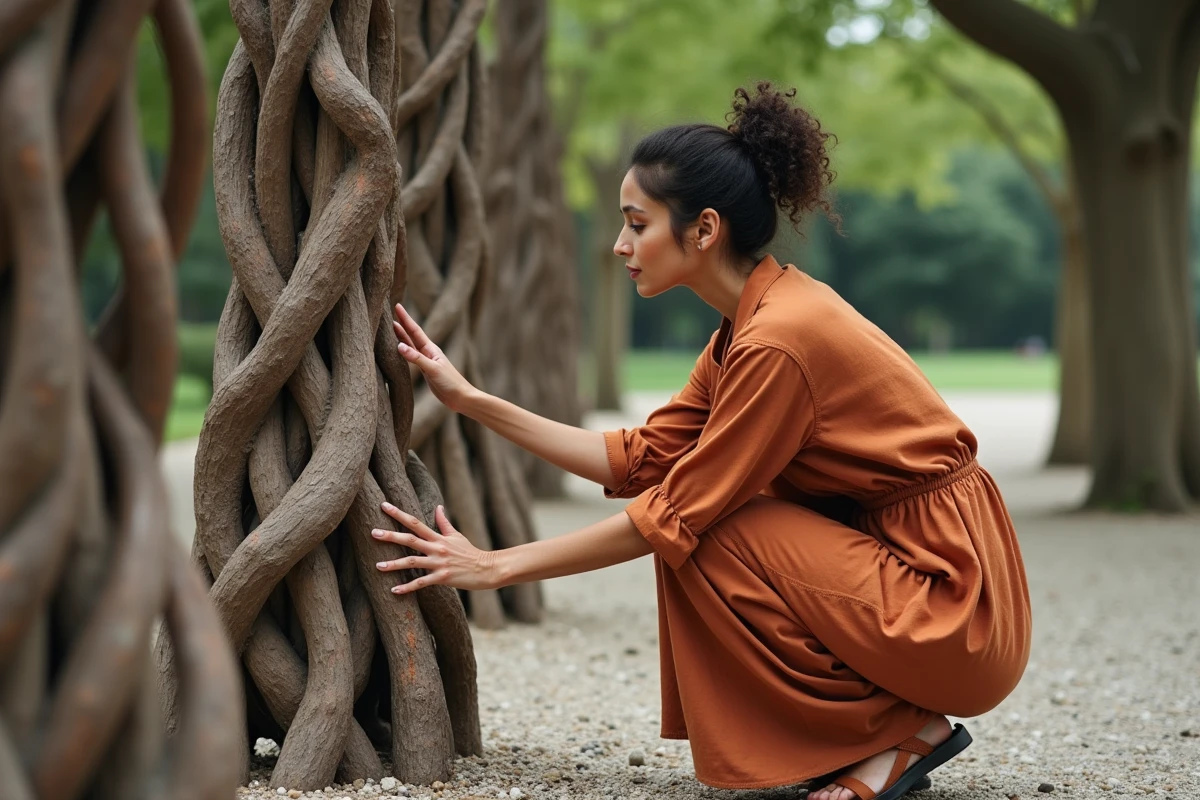
Feedback from cultural mediators provides concrete insights. During the “Vasconcelos Immersive” exhibition in Lisbon in 2025, the on-site teams observed a significant increase in intergenerational engagement. Families, in particular, noted an increased accessibility compared to usual contemporary installations.
This point deserves attention. Cultural mediation around contemporary art often stumbles on an entry problem: the uninitiated visitor does not know where to start. Vasconcelos’s interactive works offer an immediate access point, as the visitor’s body triggers visual or auditory responses. There is no need to read a three-paragraph label to engage with the piece.
Feedback varies regarding the depth of the experience depending on the installations, but the principle remains constant: the work activates through presence, not prior knowledge.
Protection of digital works and copyright in the art world
One aspect rarely addressed in artist portraits concerns the legal dimension. In 2024, a ruling by the EU Court of Justice strengthened copyright on artistic NFTs, protecting against unauthorized reproductions in the metaverse. This regulatory framework directly impacts Vasconcelos’s work, as some of her digital creations circulate in the form of non-fungible tokens.
For an artist who blends physical and digital, the question of intellectual property arises at every level:
- Is the generative algorithm used in an installation protectable in the same way as the physical sculpture?
- Do the variations produced by AI in response to visitors constitute derivative works?
- Does reproducing an interactive installation in a virtual environment constitute infringement?
These questions are not theoretical. They condition how museums and galleries negotiate exhibition rights, and they redefine the very notion of the original work in the context of contemporary art.
Crossed influences and artistic evolution towards modernity
Vasconcelos’s work is part of a lineage of artists who have refused to choose between personal engagement and formal research. In her themes, echoes of Frida Kahlo can be found in the way she transforms the intimate into plastic material, but the treatment remains resolutely contemporary.
Her evolution over the years shows a gradual shift. The early works relied more on textile creation and direct references to Lusophone heritage. Recent pieces integrate the Parisian and global digital scene, with presentations in museums that typically program technological art.
This trajectory illustrates a modernity built by successive layers, where each period adds a tool or language without erasing the previous ones. The result, when seen in the gallery, resembles neither rehashed traditional art nor pure digital art. It is a unique object, and that is precisely what makes her journey difficult to classify within the usual categories of the art world.