
When discussing advanced clay sculpture, the central question is less about the gesture and more about managing the physical constraints of the material. Uneven thicknesses, poorly sized armatures, and rapid drying: each step of the process affects the survival of the piece until firing. Comparing approaches allows us to identify where failures concentrate and how recent practices reduce risks.
Armatures and Internal Structures in Clay Sculpture
Competitors rarely address the issue of armature, mistakenly considered a topic reserved for resin or plaster sculptors. However, in clay intended for firing, the choice of internal structure conditions the stability of any piece exceeding thirty centimeters.
Three materials are commonly used in workshops: wire, wood, and aluminum foil. Each serves a different need. Wire maintains complex postures (outstretched arms, cantilevered shapes). Wood serves as a rigid backbone for busts and totems. Crumpled aluminum foil fills the interior masses and reduces the amount of clay needed, which limits variations in thickness.
The main trap: forgetting that any armature must be removed before firing. Metal and wood expand at rates incompatible with clay, causing cracks or explosions in the kiln. The solution is to design the armature as a temporary skeleton, removed once the piece can stand on its own at the leather-hard stage (semi-rigid).
For hollow forms, the sculpture is cut into sections, the armature is removed, and then reassembled with slip before final drying.
Diving deeper into the techniques of clay sculpture on Com 2 Net allows for a step-by-step visualization of this process, from assembling to disassembling the armature.
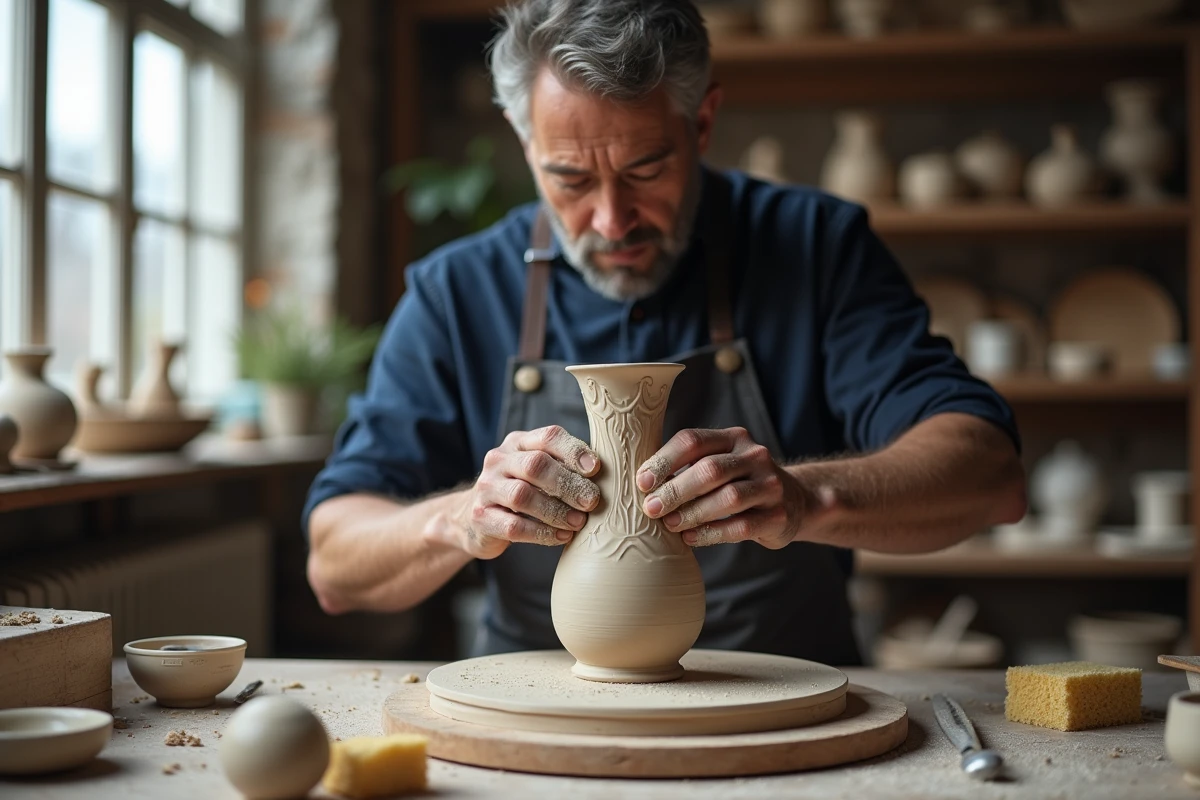
Managing Thicknesses and Hollowing: Comparative Table of Approaches
The majority of cracks in clay sculpture stem from a single cause: too marked differences in thickness within the same piece. Thicker areas dry more slowly than thinner areas, creating internal tensions that release as cracks, sometimes invisible until firing.
| Approach | Principle | Suitable for | Main Limitation |
|---|---|---|---|
| Hollowing after modeling | Carving the interior of the piece at the leather-hard stage with loop tools | Busts, compact solid forms | Risk of deforming the outer surface if the wall becomes too thin |
| Building with coils on a hollow form | Constructing directly in hollow by layering coils | Large volumes, tall sculptures | Longer assembly time, requires letting each layer firm up |
| Element assembly | Modeling head, torso, limbs separately, then assembling with slip | Articulated figures, dynamic postures | Fragile joints if the scoring and slip are insufficient |
| Fiber clay | Mixing fibers (cellulose, paper) into the clay to tolerate thickness variations | Thin works, large slabs, delicate details | Different surface texture, sometimes more odorous firing |
Fiber clay deserves special attention. In recent years, French-speaking ceramists have shared recipes incorporating cellulose into the clay. The result: larger and thinner sculptures with fewer cracks during drying. This approach also reduces the total weight of the piece, making handling easier before firing.
Complete Cycle of the Piece: From Drying to Ceramic Firing
An advanced sculptor thinks about the complete life cycle of the work from the first ball of clay. Common modeling clays fire within a range of 980-1000 °C, but remain very brittle if simply air-dried. This data imposes a clear choice from the design stage.
- Piece intended for firing: plan for sufficient hollowing, walls of regular thickness, and a vent hole to allow air to escape during the temperature rise.
- Unfired piece (decorative only): accept fragility or opt for a self-hardening clay, which does not require a kiln but offers limited mechanical strength.
- Mixed piece (permanent armature): in this case, firing is excluded. The sculptor works with slips or cold patinas for finishing.
Drying is the most underestimated step. Wrapping the piece in plastic between work sessions slows drying and prevents some areas from hardening before others. For large sculptures, drying for several weeks under perforated plastic (creating gradual evaporation) significantly reduces breakage rates.
Slip and Assembly: Common Mistakes
Slip (a liquid mixture of clay and water) serves as glue between elements. Two mistakes constantly recur in workshops. The first: applying slip to smooth surfaces. Without prior scoring of both faces, the joint does not hold. The second: assembling pieces at different drying stages. A dry element glued to a wet element almost systematically separates during drying.
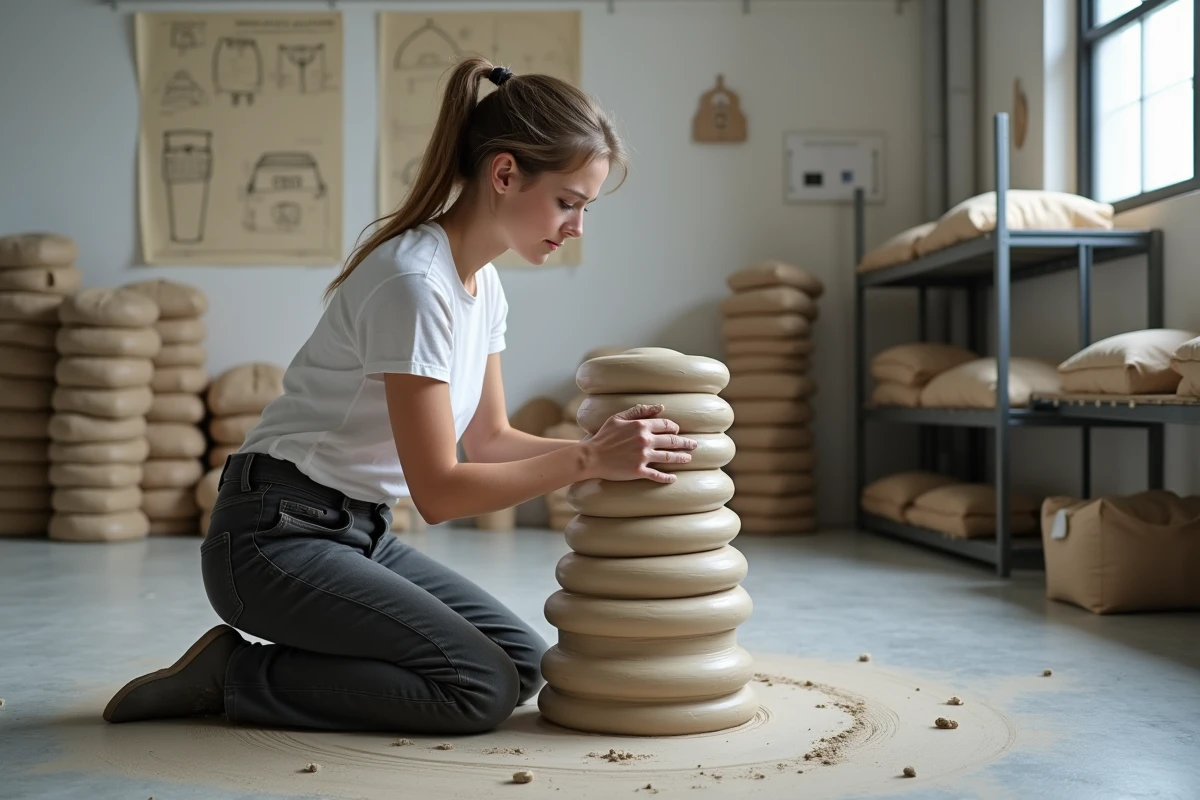
Advanced Surface Work on Clay Sculpture
The surface of a clay sculpture is not just an aesthetic concern. It influences the behavior of the piece during firing and determines the adhesion of finishes (slips, glazes, oxides).
Water smoothing, practiced by most beginners, has a rarely mentioned drawback: it saturates the surface layer with water, which can cause micro-cracks during drying if the material underneath remains drier. The preferable technique is to smooth at the leather-hard stage with a rib (a flexible blade made of metal or rubber), which compresses the surface without adding moisture.
- Metal rib: for flat surfaces and wide curves, it produces a tight and even finish.
- Flexible rib: conforms to reliefs and undercuts, suitable for faces and organic shapes.
- Loop tool: removes material by subtraction, ideal for refining overly thick modeling or carving details (orbits, folds, textures).
Applying a slip at the leather-hard stage, before the piece is completely dry, ensures better adhesion. Metal oxides, on the other hand, are often applied after a first firing (bisque), diluted in water or incorporated into a glaze.
Advanced clay sculpture relies less on the virtuosity of the gesture than on understanding the physical constraints at each stage. Controlled thicknesses, thoughtful armature, patient drying, methodical assembly: these parameters determine whether a piece survives the kiln or ends up in pieces upon unloading.